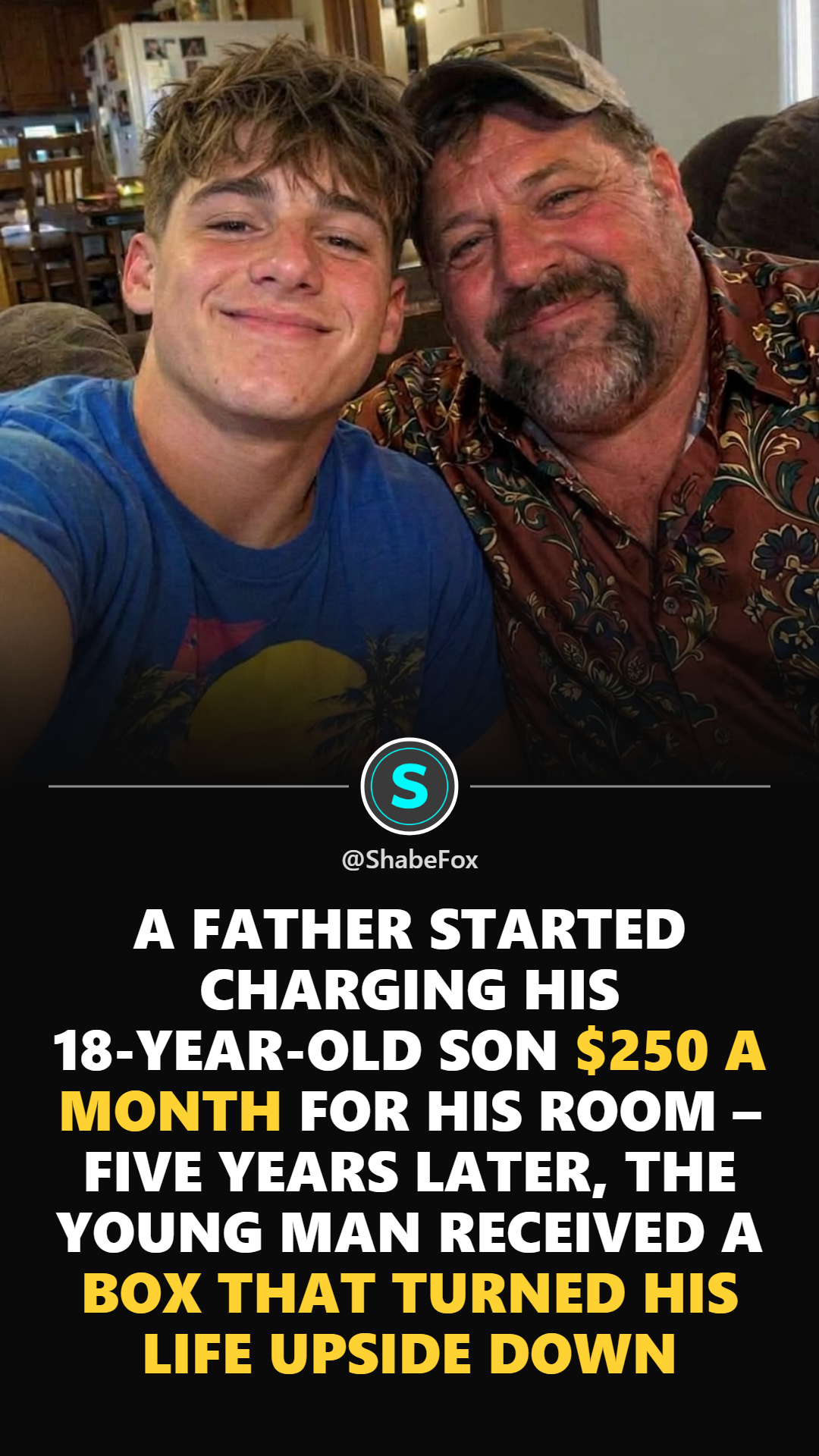

My father started charging me $250 a month for my room when I turned 18 — five years later, after his funeral, his best friend handed me a box and said, “He wanted you to open this only after he was gone.”
Mom d:ied when I was nine. Dad worked long shifts, kept food in the fridge, and signed my school forms. But he never seemed to care how my day had been.
“Can I get new shoes? These let water in,” I remember asking him once.
“Put on another pair of socks,” he said.
I had a father, but he never made much effort to be a dad.
On my eighteenth birthday, he slid a scrap of paper across the kitchen table.
“Pay me $250 for your room. On the first of every month.”
“You’re charging your own son rent?” I was stunned.
“You’re an adult now.”
I waited for him to laugh.
But Dad really did expect that $250 every month.
I stocked shelves, helped pay for groceries, and tried to save enough to move out.
Then my car would need repairs, or my hours would get cut.
Another month, another $250.
Dad would come home with beer or new fishing gear while I glued the soles back onto my work shoes.
Sometimes we went a week without speaking, passing each other in the hallway like strangers.
Five years later, Dad died suddenly.
For years, I had imagined how peaceful the house would feel without him.
Yet after the funeral, I stood staring at his work boots by the door, unable to put them away.
That evening, his best friend, Frank, knocked on the door. He was holding a cardboard box sealed with packing tape.
“Your dad left this with me.”
He set it on the kitchen table.
“He asked me to give it to you only after he was gone.”
I let out a bitter laugh.
“What, did he save every dollar of rent I paid him?”
Frank didn’t smile.
“I wouldn’t make any guesses until you see what’s inside.”
My fingers fumbled with the tape.
I lifted the flaps.
At first, I thought Frank had brought the wrong box.
Then I looked more closely and sank into Dad’s chair, sobbing so hard that Frank had to hold me upright.
For five years, my father charged me rent while I struggled financially, and I came to resent him. After his funeral, his best friend handed me a box that changed everything I thought I knew.
Before Mom passed away, our home was always filled with music.
Dad played guitar most evenings on the living room couch while Mom sang from the kitchen.
“Come on, buddy.”
Sometimes she’d use a wooden spoon as a microphone, making me laugh until I forgot the lyrics.
“Come on, buddy,” Dad would say, patting the seat beside him. “Your turn.”
I’d climb onto the couch with my toy guitar, pretending to perform before thousands.
Then Mom died when I was nine, and the music disappeared.
Dad put away his guitar and began working extra shifts, returning home exhausted and rarely speaking.
He kept the fridge stocked and signed my school paperwork, but hardly ever asked about my day.
“Can I get new shoes? These let water in,” I once asked.
“Put on another pair of socks,” he replied without looking up from dinner.
I had a father, but he rarely acted like one.
At twelve, I found old photographs in a drawer. Dad stood onstage holding a guitar, his shoulder-length hair falling around his face as a crowd cheered.
“Dad, you were in a band?”
“Long time ago.”
“What was it called? Did you make an album?”
He snatched the pictures away.
“That’s enough questions.”
But my curiosity remained.
One evening, I asked if he’d ever wanted to become famous.
He stared into his coffee.
“It was a dream once. But my time’s gone. Maybe you will inherit it.”
I didn’t understand.
By sixteen, I’d learned guitar on my own and begun writing songs. My dream was to study music production and eventually record an album.
When I showed Dad a program I hoped to attend, he barely examined the brochure.
“Music doesn’t pay the bills. Get a real job.”
“But you played music!”
“And look where it got me.”
He walked away.
That night, I noticed him standing near his old guitar. For a moment, I expected him to pick it up.
Instead, he switched off the light and went to bed.
On my eighteenth birthday, Dad pushed a scrap of paper across the breakfast table.
“Pay me $250 for your room. On the first of every month.”
I stared in disbelief.
“You’re an adult now.”
“You’re charging your own son rent?”
“It’s my birthday, Dad.”
“Then consider this your first lesson in responsibility.”
I waited for a smile, but he simply resumed drinking coffee.
I already worked part-time, yet I had to take more shifts stocking grocery shelves. After rent, food, gas, and other expenses, almost nothing remained.
Whenever I saved a little, another expense appeared. My car broke down, my hours were reduced, or my work shoes wore out.
Meanwhile, Dad occasionally bought beer or new fishing equipment.
“Must be nice having money for hobbies,” I muttered one day.
He overheard me.
“Work hard enough, and you will too.”
At nineteen, I finally saved enough for a used microphone and audio interface. I recorded songs in my bedroom, using blankets on the walls to improve the acoustics.
One night, Dad appeared at my door.
“Turn that racket down. I’ve got work tomorrow.”
“I’m almost finished.”
“I said turn it down.”
I removed my headphones.
“You couldn’t stand seeing me do something I actually love, could you?”
“I can’t stand watching you waste your life like I did.”
The argument ended when I slammed my bedroom door hard enough to knock a picture off the wall.
Eventually, I recorded less often. My guitar stayed in its case most days, though I still played whenever Dad was away.
His best friend, Frank, visited now and then. Sometimes they left carrying tools or old equipment. I assumed they were working in Frank’s garage.
By twenty-three, Dad and I barely exchanged words.
We passed each other in the hallway like strangers, and I left $250 on the kitchen table every month.
Sometimes I’d notice him watching me, but he never spoke.
Five years after he began collecting rent, Dad died of cancer.
I’d often imagined the relief of having the house to myself. Yet after his funeral, I stood in the hallway staring at his work boots beside the door, unable to move them.
We’d barely spoken during his last week. Our final conversation concerned a leaking kitchen faucet.
Now we’d never speak again.
That evening, someone knocked.
It was Frank, Dad’s oldest friend, carrying a cardboard box sealed with tape.
“Your dad left this with me.”
He placed it on the kitchen table.
“He wanted you to open this only after he was gone.”
I laughed bitterly.
“What, did he save every dollar of rent I paid him?”
Frank remained serious.
“I wouldn’t make any guesses until you see what’s inside.”
I ripped away the tape and opened the box.
At first, I wondered if he’d brought the wrong one.
Inside lay an old leather vest covered with band patches, backstage passes, guitar picks, and pictures of Dad performing.
Then I found a photograph of Mom.
She stood beside Dad, smiling at him as he played. He looked happier than I’d seen him in fourteen years.
Memories of those musical evenings in our living room flooded back.
I collapsed into Dad’s chair, crying so hard that Frank had to support me.
He stayed until I’d calmed down, then quietly left.
While putting the pictures away, I noticed something metallic beneath the vest.
It was a key with a small tag bearing an unfamiliar address.
I turned it over, searching for an explanation.
Nothing.
There was no note anywhere in the box.
I grabbed my jacket and car keys.
The address led to the edge of town, beyond warehouses and an abandoned gas station.
Despite living here all my life, I couldn’t recall visiting this area.
I checked the tag again. The address matched.
“What were you doing out here, Dad?” I whispered.
I circled the building, looking for clues. There was no sign, no parked vehicles, and nothing visible through the windows.
It seemed abandoned except for a clean welcome mat near the entrance.
I inserted the key. It turned easily.
I hesitated, afraid I might uncover something about Dad I’d rather never know.
Then I opened the door, switched on the lights, and stepped inside.
I froze, struggling to understand what stood before me.
Dark acoustic panels lined the walls. A large mixing desk occupied one corner, surrounded by speakers and computer monitors. Microphones stood near guitar amplifiers, while a drum kit sat behind a glass partition.
It was a recording studio.
I walked farther in, brushing my fingers over the mixing desk. Everything was spotless, as though someone maintained it regularly.
“Dad?” I whispered, almost expecting an answer.
Then I noticed a wall covered with photographs, concert posters, and newspaper clippings.
One picture showed Dad twenty years younger, holding his guitar high beneath bright stage lights.
Another captured a crowd reaching toward the stage.
I examined a newspaper clipping.
“Local Rock Band Packs Riverside Theater for Third Consecutive Weekend.”
I read it twice.
My father had performed before packed audiences. People had paid to watch him.
Yet he’d never told me.
“Why did you hide all this?” I murmured.
I approached the instruments.
Electric guitars, a keyboard, and professional recording equipment filled the room. I recognized an audio interface that once cost more than three months of my wages.
Then I spotted something beside the keyboard.
A battered black guitar with a tiny silver star sticker near its neck.
My guitar.
I’d purchased it secondhand at sixteen and played almost daily until my arguments with Dad became unbearable.
It eventually disappeared while I was clearing my room, and I’d assumed I’d accidentally thrown it away.
But here it stood, fitted with fresh strings.
I picked it up and examined it.
Someone had even repaired the crack near the bridge.
My throat tightened.
For the first time, I wondered whether Dad had built this studio for someone other than himself.
For me.
But why? And why had he seemed to hate music?
I carefully returned the guitar to its stand.
Beside the mixing desk lay a small flash drive.
I picked it up. A piece of tape bore two words in Dad’s handwriting:
“Our Band.”
I plugged it into a nearby computer and found one video.
I clicked “Play.”
The screen flickered, revealing grainy footage of four young men rehearsing in a cramped garage.
There was Dad, his hair past his shoulders, playing guitar with a cigarette tucked behind his ear.
“Come on, Frank!” he shouted at the drummer. “My grandma can keep a better beat than that!”
“Then invite her to join the band!”
Everyone burst into laughter.
The footage shifted between performances, backstage clips, and hilarious rehearsal moments.
In one scene, Dad attempted to leap from a speaker but landed on his backside.
In another, the bassist knocked over a tray of drinks.
I laughed until tears filled my eyes.
I’d never known this version of Dad. He was energetic, hilarious, and outspoken, nothing like the silent man I’d eaten breakfast with.
Then the video abruptly stopped.
The screen went dark.
Seconds later, Dad appeared.
Not the young musician from the footage, but the man we’d buried that morning.
He sat in the same studio, his face gaunt and most of his hair gone from cancer.
“Hey, son.”
My breath caught.
He looked at his hands before speaking again.
“I’ve never been good at this stuff. Talking about feelings. You know that better than anybody.”
He tried to smile.
“First thing I want to say is… I’m sorry.”
I gripped the desk.
“I spent so much time worrying about making sure you had a decent life that I forgot something pretty important. Life’s supposed to make you happy, too. Not just pay the bills.”
He shook his head.
“When your mom died, I got scared. I thought if I worked hard enough, kept a roof over our heads, and made sure you learned to stand on your own two feet, I’d be doing my job.”
He paused.
“Somewhere along the way, I forgot how to be your dad.”
He swallowed, and my eyes filled with tears.
“A while back, I started watching these old recordings. Just feeling nostalgic, I guess. And I remembered how much I loved playing music. How happy it made me. Then I remembered how you used to look when you played.”
“And I realized I’d spent years trying to protect you from the very thing that once made my own life worth living.”
Dad wiped his eyes.
“By then, we’d barely spoken in years. I wanted to tell you everything, but I knew how it would look. Like I was trying to buy your forgiveness with some expensive gift.”
He gestured around the studio.
“So I made a decision. I asked Frank to give you that box only after I was gone. Because I don’t want you to feel like you owe me anything. Not forgiveness. Not gratitude. Not even a phone call.”
He drew an unsteady breath.
“When you get this place, it’ll be yours. You can make music, sell the equipment, turn it into something else. Whatever makes you happy. And I won’t be around to tell you you’re doing it wrong.”
For a moment, he stared into the camera.
Then someone entered the frame.
Frank.
He rested a hand on Dad’s shoulder.
“We’ve got his back, buddy.”
Two more men joined him. I recognized them from the pictures on the studio walls.
The bassist grinned.
“Besides, once you’re gone, we’re going to need a new guitarist.”
“And a singer,” the drummer added. “Preferably one who can actually hit the high notes.”
Dad laughed, wiping his face.
“You hear that, son? Apparently, they’re already planning to replace me.”
He looked at his former bandmates, then back at the camera.
“Seriously, though. These idiots have been my friends for most of my life. They’ll help you if you want to give music a shot. And if you don’t, they’ll respect that too.”
The men moved away, leaving Dad alone.
“One last thing. Open the drawer under the mixing desk. There’s something in there to help you get started.”
His voice trembled.
“I wish I’d been a better father. I wish we’d had more time. But most of all, I wish I’d told you how proud I am of you.”
A tear slipped down his cheek.
“I love you, son. I always have.”
He reached toward the camera.
“Goodbye, buddy.”
The screen went black.
I sat motionless before folding forward and crying harder than I had at his funeral.
Eventually, I opened the drawer beneath the mixing desk.
Inside sat a wooden box containing neatly arranged envelopes.
Each was marked with a month and year.
I opened one.
Two hundred-dollar bills and a fifty.
The next contained exactly the same amount.
There were sixty envelopes.
Every $250 rent payment I’d made over five years.
Fifteen thousand dollars.
On top was a handwritten note from Dad.
“You earned every dollar of this. Don’t waste it the way I wasted my chance.”
I pressed the paper against my chest.
For five years, I’d believed Dad was taking away my future, $250 at a time.
All along, in his stubborn and deeply misguided way, he’d been trying to give it back.
I looked toward the dark computer screen.
“Thanks, Dad,” I whispered. “I just wish you’d told me while you were here.”