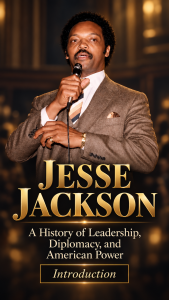
Jesse Louis Jackson is one of the most prominent American civil rights leaders to emerge from the generation shaped by Martin Luther King Jr. His public career has stretched across more than six decades and has included civil rights organizing, religious leadership, economic activism, international diplomacy, electoral politics, and two historically important campaigns for the presidency of the United States.
Jackson’s life is closely connected to the transformation of American society after the Second World War. He was born in the segregated South, grew up under Jim Crow, became involved in the student civil rights movement, worked with Martin Luther King Jr. and the Southern Christian Leadership Conference, organized campaigns for economic opportunity in Chicago, created his own national civil rights organizations, and eventually entered presidential politics.
His presidential campaigns in 1984 and 1988 were especially important. Jackson did not win the Democratic nomination, but his campaigns demonstrated the increasing electoral influence of African American voters and attempted to create a broad political coalition involving Black Americans, Latinos, working-class voters, farmers, labor activists, peace advocates, and other groups. The coalition became associated with Jackson’s idea of a “Rainbow Coalition.”
Jackson’s career also contained controversies and internal disagreements. His relationships with other civil rights leaders were sometimes competitive. Some of his public statements generated strong criticism. His political strategies were debated both inside and outside the African American community.
A serious history of Jesse Jackson therefore requires more than presenting him either as a hero or as a controversial political personality.
His life needs to be understood within the historical circumstances that shaped it.
To understand Jesse Jackson, we must begin in Greenville, South Carolina, during the era of racial segregation.
Chapter 1: Birth in the Segregated South
Jesse Louis Jackson was born on October 8, 1941, in Greenville, South Carolina.
The South Carolina into which he was born was profoundly segregated.
Jim Crow laws and customs separated Black and white Americans in schools, transportation, restaurants, hotels, public facilities, housing, employment, and many other areas of life.
Segregation was not merely a matter of people living separately. It formed part of a political, economic, and social system that restricted the rights and opportunities of African Americans.
Black citizens throughout the South faced obstacles to voting. Schools for Black children generally received fewer resources than white schools. Employment discrimination limited economic advancement. Racial violence and intimidation reinforced the system.
Jackson was therefore born into a society in which race could determine where a person attended school, where a family lived, what employment opportunities were available, and whether an individual could exercise basic political rights.
His family circumstances presented additional difficulties.
His mother, Helen Burns, was a teenager when Jesse was born and was unmarried at the time. His biological father was Noah Louis Robinson.
Jackson was later raised in the household of his mother and his stepfather, Charles Henry Jackson, whose surname Jesse eventually took.
Growing up under these circumstances influenced Jackson’s understanding of social status and exclusion.
In later life, he frequently spoke about people who had been pushed to the margins of society. His political language often emphasized the idea that people should not allow the circumstances of their birth or poverty to determine their future.
This message was rooted partly in his own experience.
Chapter 2: Greenville and Jim Crow
Greenville was an industrializing Southern city, but racial segregation remained embedded in daily life.
For a Black child growing up in the 1940s and 1950s, the racial hierarchy was impossible to ignore.
There were spaces where Black citizens were unwelcome.
There were businesses where Black customers could spend money but could not expect equal treatment.
There were jobs that were effectively unavailable to Black workers regardless of their abilities.
There were schools separated by race.
These conditions existed not because Black citizens accepted inequality but because political institutions and social customs had been constructed to maintain it.
Yet the Black community of Greenville also possessed important institutions of its own.
Churches played particularly significant roles.
African American churches were not simply places of worship. They frequently functioned as centers of education, political organization, community support, communication, and leadership.
This religious environment later became central to Jackson’s identity.
He would eventually become an ordained Baptist minister, combining religious language with civil rights and political activism.
That combination placed him within a long tradition of Black religious leadership in the United States.
Martin Luther King Jr. was part of that tradition.
So were Ralph Abernathy, Fred Shuttlesworth and many other leaders of the civil rights movement.
Jackson would eventually work alongside them.
But first he had to find his own path.
Chapter 3: School, Sports, and Ambition
As Jackson grew older, he demonstrated ability both academically and athletically.
Football became particularly important.
Athletic success provided opportunities for young Black men during an era when many other routes to advancement remained restricted.
Jackson attended Sterling High School, a segregated Black school in Greenville.
He became an accomplished student and athlete and served as class president.
These early experiences provided opportunities to develop leadership skills.
Sports also taught lessons that later appeared repeatedly in Jackson’s public life.
Competition required discipline.
Teams required cooperation.
Victory depended on organizing people around common objectives.
Leadership required confidence.
Jackson’s personality was increasingly suited to public roles. He was ambitious, energetic, competitive, and comfortable speaking before groups.
After high school, his athletic ability helped him gain access to higher education.
In 1959, he enrolled at the University of Illinois on an athletic scholarship.
Leaving South Carolina exposed him to a different part of American society.
But moving north did not mean escaping racial discrimination.
Chapter 4: The University of Illinois
The University of Illinois offered Jackson educational and athletic opportunities, but his experience there also demonstrated that racial inequality was not limited to the South.
Northern states did not generally maintain the same formal Jim Crow legal system found across the Deep South.
Yet discrimination existed in housing, employment, education, social life, and other areas.
For Black Americans of Jackson’s generation, this distinction became increasingly important.
The civil rights struggle had initially focused heavily on Southern segregation because its legal structure was explicit.
But activists gradually confronted a broader question.
What did equality mean if discriminatory laws disappeared but economic and social inequality remained?
This question would later become central to Jackson’s career.
He spent only a year at Illinois before transferring to North Carolina Agricultural and Technical State University, commonly known as North Carolina A&T.
The move proved historically significant.
At North Carolina A&T, Jackson entered an institution that was becoming closely connected to one of the most important phases of the civil rights movement.
Chapter 5: North Carolina A&T and the Student Movement
North Carolina A&T was a historically Black college in Greensboro, North Carolina.
In February 1960, four A&T students, Ezell Blair Jr., Franklin McCain, Joseph McNeil, and David Richmond, sat at a whites-only lunch counter at a Woolworth store in Greensboro.
They asked to be served.
They were refused.
Instead of leaving, they remained seated.
The action helped ignite a wave of student sit-ins across the South.
Young African Americans entered segregated restaurants and other public facilities, peacefully demanded service, and refused to leave when denied equal treatment.
The demonstrations represented an important change in the civil rights movement.
Young people were no longer waiting for established organizations or older leaders to direct every action.
Students were becoming organizers themselves.
Jackson entered this politically charged environment.
At North Carolina A&T, he became involved with the local Congress of Racial Equality organization and participated in sit-ins and demonstrations against segregation.
The experience was transformative.
Civil rights was no longer simply an issue he observed.
He was participating directly.
Chapter 6: The Student Civil Rights Revolution
The early 1960s represented a remarkable period of activism.
The Montgomery Bus Boycott of 1955–1956 had already demonstrated the power of sustained nonviolent protest.
The sit-in movement expanded that strategy.
Students challenged segregation directly by placing their bodies in spaces where the racial system said they did not belong.
The method was simple but powerful.
A lunch counter could become a political battleground.
A bus terminal could expose the contradictions between constitutional equality and segregation.
A voter registration office could reveal how local officials prevented Black citizens from exercising political rights.
The movement also demonstrated the importance of media.
Images of peaceful protesters being arrested, beaten, or attacked could reach audiences across the country and around the world.
This created political pressure on local governments, businesses, Congress, and the White House.
Jackson learned organizing in this environment.
He observed that protest required more than passionate speeches.
Successful movements needed transportation, communication, fundraising, recruitment, planning, discipline, publicity, and negotiation.
These practical lessons became crucial later in his career.
Chapter 7: Religion and Social Action
Jackson’s political development was closely connected to religion.
Christianity had played an important role in African American resistance for generations.
During slavery, biblical stories of liberation offered spiritual hope.
After emancipation, Black churches became some of the most important independent institutions controlled by African Americans.
During the civil rights movement, churches frequently provided meeting spaces, leadership networks, financial support, and organizational infrastructure.
Martin Luther King Jr. expressed civil rights goals through explicitly religious language.
Segregation was not merely politically unjust.
It was morally wrong.
Nonviolence was not simply a political tactic.
For King, it was connected to a broader philosophy of love, human dignity, reconciliation, and Christian ethics.
Jackson was drawn toward this combination of ministry and social action.
He graduated from North Carolina A&T in 1964.
That same year, the Civil Rights Act became federal law.
The legislation prohibited discrimination in important areas of public life and employment.
It represented one of the greatest legislative victories of the civil rights movement.
But the struggle was far from finished.
Voting discrimination remained widespread.
Poverty remained severe.
Residential segregation persisted.
Economic inequality remained deeply entrenched.
Jackson was about to enter the movement full time.
Chapter 8: Chicago Theological Seminary
After graduating from college, Jackson moved to Chicago.
He began studying at Chicago Theological Seminary through a Rockefeller-funded opportunity.
Chicago exposed him to a different racial landscape.
The city did not operate under the formal Jim Crow system of South Carolina.
Nevertheless, racial segregation was deeply embedded in housing and neighborhoods.
Black families frequently encountered discrimination when attempting to rent or purchase homes outside designated areas.
Schools reflected residential segregation.
Employment discrimination restricted economic opportunity.
Poverty and overcrowding affected many Black neighborhoods.
The situation demonstrated that civil rights legislation alone could not eliminate racial inequality.
Removing a “Whites Only” sign was comparatively straightforward.
Changing housing markets, employment practices, school systems, banking patterns, and neighborhood politics was far more complicated.
This distinction would eventually push the civil rights movement toward economic questions.
Jackson was particularly suited to this transition.
His most important early work would focus not only on legal rights but also on jobs, businesses, consumer power, and economic opportunity.
Before that happened, however, another major civil rights confrontation drew him back South.
Chapter 9: Selma
In 1965, voting rights activists were campaigning in Selma, Alabama.
Black residents faced severe obstacles to voter registration.
Martin Luther King Jr. and the Southern Christian Leadership Conference joined local activists in a campaign designed to bring national attention to voting discrimination.
Events escalated after activist Jimmie Lee Jackson was shot by an Alabama state trooper during a confrontation following a protest. He died from his wounds several days later.
Activists planned a march from Selma to Montgomery.
On March 7, 1965, marchers attempting to cross the Edmund Pettus Bridge were attacked by Alabama state troopers and local law enforcement officers.
Television images of the violence shocked viewers around the country.
The day became known as Bloody Sunday.
Martin Luther King Jr. called for religious leaders and supporters from around the country to come to Selma.
Jackson responded.
He organized fellow students from Chicago to travel south.
The experience brought him directly into King’s movement.
Chapter 10: Meeting Martin Luther King Jr.
Martin Luther King Jr. was already internationally famous when Jackson entered his orbit.
King had emerged as a national figure during the Montgomery Bus Boycott.
He later became president of the Southern Christian Leadership Conference, or SCLC.
The organization helped coordinate nonviolent civil rights campaigns throughout the South. Its work contributed to the national pressure surrounding both the Civil Rights Act of 1964 and the Voting Rights Act of 1965.
Jackson wanted to become more deeply involved.
His personality differed in some respects from King’s.
King was an intellectual minister whose public leadership emphasized moral persuasion, nonviolence, democratic ideals, and Christian theology.
Jackson possessed strong preaching abilities but was also intensely interested in organization, economic leverage, negotiation, and political mobilization.
The differences could complement one another.
They could also create tension.
King eventually gave Jackson an opportunity to work with SCLC.
It would transform Jackson’s career.
Chapter 11: The Chicago Freedom Movement
By the mid-1960s, King and SCLC were increasingly concerned that legal victories in the South had not solved the economic and social problems confronting Black Americans.
Chicago became an important test.
SCLC’s Chicago campaign focused on problems including housing discrimination, poverty, education, and economic inequality.
King moved into a Chicago apartment to dramatize the conditions experienced by Black residents.
Demonstrations challenged discriminatory housing practices.
Marchers encountered intense hostility in some white neighborhoods.
King himself was struck by a rock during one demonstration.
The Chicago campaign revealed the difficulty of applying strategies developed against Southern legal segregation to Northern economic and residential inequality.
There was rarely a single law that could simply be overturned to solve these problems.
Housing inequality involved landlords, banks, real estate companies, zoning practices, neighborhood resistance, government policy, and economic conditions.
SCLC needed new approaches.
One of the most promising was Operation Breadbasket.
And Jesse Jackson would become its most visible leader.
Chapter 12: Operation Breadbasket
Operation Breadbasket had been established by SCLC before Jackson took control of its Chicago program.
Its strategy centered on economic power.
The principle was straightforward.
Black consumers spent substantial amounts of money with major companies.
If those companies benefited from Black customers while refusing to hire Black employees or do business with Black-owned firms, activists could use consumer pressure to demand change.
This represented a different kind of civil rights strategy.
Instead of relying exclusively on court decisions or legislation, activists used the marketplace.
They gathered information about employment.
They negotiated with companies.
When businesses refused to change their practices, activists could organize boycotts and encourage consumers to stop purchasing their products.
The approach connected civil rights with economics.
Jackson proved exceptionally effective at organizing this work in Chicago.
The King Institute records that Chicago Breadbasket targeted industries including dairy companies, soft-drink bottlers, and supermarket chains. The campaign obtained thousands of jobs and generated millions of dollars in new income for Black workers.
King described Operation Breadbasket as one of SCLC’s most successful Chicago programs.
Jackson’s reputation grew rapidly.
Chapter 13: Economic Power as Civil Rights
Operation Breadbasket represented an important expansion of civil rights strategy.
Earlier campaigns had often focused on access.
Could a Black customer sit at a lunch counter?
Could a Black passenger sit anywhere on a bus?
Could a Black child attend an integrated school?
Could a Black citizen register to vote?
Breadbasket asked another question.
What good was legal access if economic opportunity remained unequal?
A person could legally enter a supermarket, but what if the supermarket refused to employ Black managers?
A company could sell millions of dollars of products in Black neighborhoods while investing little in those communities.
Jackson argued that consumer spending could become a source of political leverage.
The idea was memorable because it transformed ordinary purchasing decisions into collective action.
Families buying groceries became participants in an economic campaign.
Churches could organize consumers.
Ministers could communicate with thousands of people each week.
Businesses could be confronted not only with moral arguments but with financial consequences.
This approach became one of Jackson’s lasting contributions to civil rights activism.
Decades later, his organizations would continue pressing corporations over minority hiring, contracts, investment, and business opportunities.
Chapter 14: Jackson’s Growing Reputation
Operation Breadbasket turned Jackson into a nationally recognized civil rights figure.
He was young, energetic, charismatic, and effective before an audience.
His speaking style drew heavily on the Black church tradition.
He used repetition.
He used rhythm.
He used call-and-response.
He transformed political arguments into memorable phrases.
These abilities would later become central to his presidential campaigns.
But charisma created complications as well.
Civil rights organizations contained ambitious individuals with different strategies and personalities.
Jackson’s rapid rise generated tension.
Some colleagues believed he sought publicity too aggressively.
Others admired his organizing ability and capacity to mobilize crowds.
King himself appears to have held a complicated view.
He recognized Jackson’s talents and promoted him. The King Institute records that King praised Jackson’s effectiveness with Breadbasket and elevated him to national leadership of the program.
At the same time, King could become frustrated when Jackson appeared to pursue his own agenda rather than the organization’s collective priorities.
These tensions became especially significant during King’s final months.
Chapter 15: From Civil Rights to Economic Justice
By 1967 and 1968, Martin Luther King Jr.’s political agenda was expanding.
The great legislative victories of 1964 and 1965 had transformed federal law.
But King increasingly argued that legal equality was insufficient without economic justice.
Poverty affected Americans across racial lines.
King began planning the Poor People’s Campaign, which aimed to bring poor Americans to Washington and demand action on employment, income, housing, and economic opportunity.
This represented an important shift.
The movement was attempting to create a coalition based partly on economic class rather than race alone.
Poor Black Americans remained central, but King hoped to include poor white Americans, Latinos, Native Americans, and others.
This idea anticipated some elements of Jackson’s later Rainbow Coalition.
Jackson’s own work with Operation Breadbasket was already centered on economic empowerment.
The two leaders therefore shared an interest in moving the freedom struggle beyond formal desegregation.
Their methods and personalities differed, but the economic dimension of King’s final campaigns became an important bridge to Jackson’s later work.
Chapter 16: Memphis and the Sanitation Workers
In early 1968, Black sanitation workers in Memphis, Tennessee, went on strike.
The workers faced dangerous conditions, low pay, and discriminatory treatment.
The strike became a major civil rights struggle.
Their slogan, “I AM A MAN,” expressed the deeper meaning of the campaign.
The workers were demanding more than higher wages.
They were demanding dignity.
King traveled to Memphis to support them.
The campaign connected directly to his growing focus on economic justice.
Jackson also became involved.
The relationship between Jackson and King had experienced tension shortly before King’s death. According to historical accounts preserved by the King Institute, King had criticized Jackson for acting independently of SCLC’s broader agenda, but the two reconciled and Jackson joined him in Memphis.
Neither man knew that the trip would become one of the defining moments of Jackson’s life.
Chapter 17: April 4, 1968
Martin Luther King Jr. stayed at the Lorraine Motel in Memphis.
On April 4, 1968, King stepped outside his room onto the motel balcony.
He was shot.
Jackson was among the people at the motel during King’s final moments. Historical accounts place him below the balcony shortly before the assassination.
King’s death produced shock across the United States and around the world.
For Jackson, it was both a personal and political turning point.
The man who had given him an opportunity inside the national civil rights movement was gone.
SCLC had lost its central leader.
The movement itself entered a period of uncertainty.
King had possessed an unusual ability to connect religious leadership, nonviolent protest, national media attention, grassroots activism, and access to political leaders.
No single individual could simply replace him.
The question was what would happen next.
Chapter 18: America After King’s Assassination
King’s assassination triggered grief and anger.
Disturbances erupted in numerous American cities.
President Lyndon Johnson called for calm and urged Congress to act on civil rights legislation.
Within days, the Fair Housing Act of 1968 became law.
But legislation could not resolve the deeper crisis.
The civil rights movement had already been changing before King’s death.
Younger activists increasingly questioned nonviolence and interracial liberalism.
The slogan “Black Power” had gained prominence.
Urban unrest had exposed frustration over policing, unemployment, poverty, and housing.
The Vietnam War had divided American society.
King himself had become an outspoken critic of the war.
His Poor People’s Campaign was attempting to redirect national attention toward economic inequality.
After his death, the movement became more fragmented.
Different leaders pursued different strategies.
Some focused on electoral politics.
Some emphasized Black nationalism.
Some concentrated on community organizations.
Some continued King’s philosophy of nonviolent protest.
Jackson increasingly developed his own approach.
Chapter 19: The Struggle Over King’s Legacy
The period after King’s death was difficult for SCLC.
Ralph Abernathy succeeded King as president of the organization.
But replacing King institutionally was easier than replacing his symbolic authority.
Jackson remained responsible for Operation Breadbasket and continued expanding his public profile.
This created tension.
Who represented King’s legacy?
Who had authority over economic programs?
Should SCLC’s national headquarters remain the center of decision-making, or should strong local leaders have greater independence?
These were organizational questions, but they were also questions of personality and power.
Jackson’s Chicago operation had developed its own network of ministers, activists, businesses, and supporters.
His style was increasingly independent.
The disagreement with SCLC leadership eventually became impossible to resolve.
In 1971, Jackson left SCLC.
The separation marked the end of one phase of his life.
He was no longer primarily a young lieutenant in Martin Luther King Jr.’s organization.
He was about to become the leader of an organization of his own.
Chapter 20: The Birth of Operation PUSH
After leaving SCLC, Jackson created People United to Save Humanity, commonly known as Operation PUSH.
The organization was based in Chicago.
PUSH continued many of the themes Jackson had developed through Operation Breadbasket.
Economic empowerment remained central.
Corporations were pressured to expand opportunities for Black workers and businesses.
Education became another major concern.
Jackson emphasized personal discipline alongside structural reform.
This combination became characteristic of his public message.
He argued that governments and corporations had responsibilities to address discrimination and inequality.
But he also emphasized education, family responsibility, self-respect, and community organization.
This allowed him to speak simultaneously in the language of civil rights activism and the language of personal improvement.
PUSH also provided Jackson with an independent institutional base.
That mattered enormously.
Civil rights leaders who depended entirely on larger organizations could lose influence when leadership changed.
Jackson now had his own organization.
He could establish priorities.
He could raise money.
He could organize national campaigns.
He could develop media relationships.
He could train supporters.
And he could build a political constituency.
The civil rights organizer was gradually becoming a national political leader.
Chapter 21: The 1970s and a Changing America
The United States changed significantly during the 1970s.
The Vietnam War ended.
The Watergate scandal damaged public confidence in government.
Richard Nixon resigned the presidency in 1974.
Economic problems including inflation and unemployment placed pressure on working families.
Cities experienced fiscal difficulties and industrial decline.
Many manufacturing jobs began disappearing from urban communities.
For Black Americans, the decade brought both progress and continuing inequality.
African Americans increasingly won elected office.
Black mayors took office in major cities.
Universities and corporations expanded opportunities.
Affirmative-action policies attempted to address historical discrimination.
A growing Black middle class gained access to professions and institutions previously closed to them.
Yet severe problems remained.
Many inner-city neighborhoods experienced unemployment, inadequate schools, housing problems, crime, and declining investment.
Jackson’s activism increasingly addressed these economic conditions.
The question was no longer simply whether Black Americans possessed legal rights.
The question was whether those rights could be translated into economic and political power.
Chapter 22: From Protest to Politics
The civil rights movement had always contained a political dimension.
Voting rights were political.
Federal legislation was political.
Appointments to government positions were political.
But by the 1970s, Black political participation had expanded dramatically.
The Voting Rights Act helped remove barriers to registration across the South.
African American candidates increasingly won elections at local, state, and federal levels.
Jackson recognized that demonstrations and boycotts alone could not achieve every goal.
Political institutions controlled budgets, laws, appointments, and public programs.
Black citizens needed influence inside those institutions.
Voter registration therefore became increasingly important to his work.
Jackson’s ability to speak before large crowds made him a natural campaign figure.
His experience negotiating with corporations also gave him a broader understanding of power.
Politics was becoming an increasingly logical next step.
But Jackson did not initially seek conventional elected office.
His ambition was larger.
He wanted to create a national coalition.
Chapter 23: The Rainbow Idea
The idea of a “Rainbow Coalition” became central to Jackson’s political identity.
The concept was based on coalition politics.
African Americans alone represented an important but limited percentage of the national electorate.
A successful movement for economic and political change therefore required cooperation with other groups.
Jackson attempted to bring together African Americans, Latinos, Native Americans, Asian Americans, working-class whites, farmers, labor activists, women, young people, religious communities, peace activists, and other constituencies.
The coalition was called a rainbow because its different groups could retain their identities while working together around shared interests.
This represented an evolution from traditional civil rights politics.
The movement was no longer framed exclusively as Black Americans demanding inclusion from white America.
Jackson increasingly presented inequality as a problem affecting multiple groups.
A factory closing could harm Black and white workers.
Farm debt could devastate rural communities.
Poor schools could affect families across racial categories.
Limited access to health care could create common interests among people who otherwise had very different backgrounds.
The challenge was transforming these shared problems into a durable political organization.
Jackson would attempt to do that on the largest possible stage.
Chapter 24: Toward a Presidential Campaign
By the early 1980s, Jackson had become one of America’s most recognizable Black leaders.
The political environment was changing again.
Ronald Reagan won the presidency in 1980.
His administration advocated lower taxes, reduced federal regulation, increased defense spending, and a more conservative approach to many domestic policies.
Many civil rights leaders strongly opposed aspects of Reagan’s agenda.
Jackson increasingly argued that marginalized voters needed a stronger voice within national politics.
The Democratic Party depended heavily on African American voters, but no Black candidate had become a serious contender for its presidential nomination.
Jackson decided to challenge that pattern.
In 1983, he announced that he would seek the Democratic presidential nomination in the 1984 election.
The decision was historic.
His campaign was not the first presidential candidacy by an African American.
But Jackson’s campaign would reach a scale of national electoral support not previously achieved by a Black presidential candidate.
The young man who had participated in sit-ins at North Carolina A&T was preparing to compete for the presidency of the United States.
His candidacy would transform both his own career and the political influence of African American voters.
And it would become the beginning of the most politically significant period of Jesse Jackson’s life.
