Perimenopause Fitness
• Updated Nov 2026
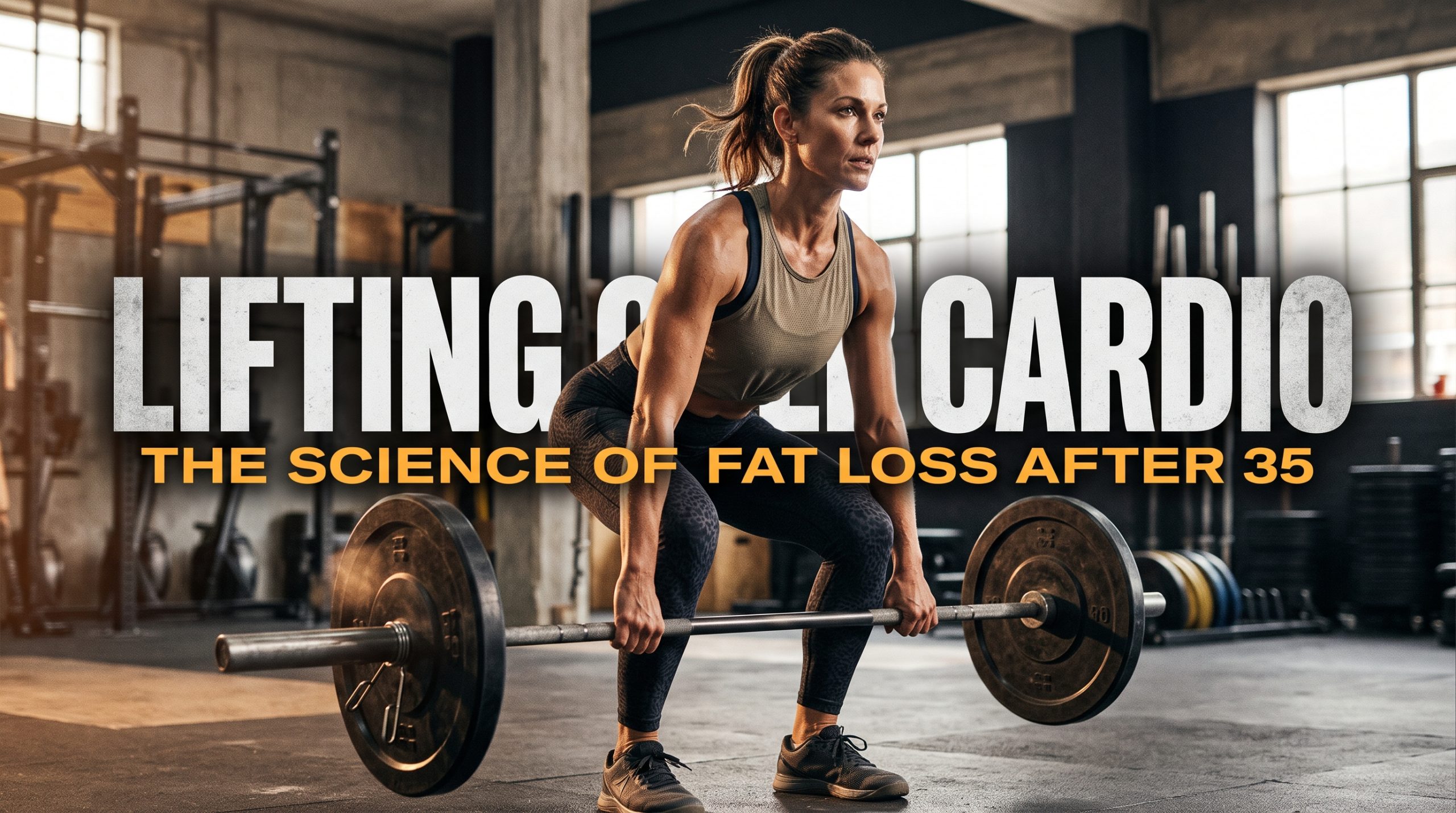
Why Cardio Stops Working After 35: The Science of Heavy Lifting for Fat Loss
Written by Dr. Sarah Mitchell, MD | Exercise Endocrinologist
Reviewed by Board Certified Sports Nutritionists & Physiological Researchers
Key Takeaways (The Quick Read)
- 1.
The Neuroendocrine Shift: After 35, progesterone drops and estrogen fluctuates unpredictably, reducing anabolic drive and baseline sleep quality. - 2.
The Cardio Cortisol Trap: Excessive cardio elevates cortisol, which breaks down muscle tissue for fuel and drives visceral fat deposition directly around the midsection. - 3.
The Solution: Heavy progressive strength training (6–10 reps) releases visceral-fat-melting myokines (IL-15), prevents sarcopenia, and triggers 48-hour EPOC calorie burn.
In This Clinical Guide:
There is a distinct, frustrating moment that arrives for millions of women in their late thirties and early forties.
You find yourself doing everything that previously kept you fit, lean, and energetic. You lace up your running shoes four mornings a week, log five miles on the road, push through exhausting 45-minute cycling sessions, track your steps obsessively, and maintain a strict calorie deficit.
Yet, despite working twice as hard as you did in your twenties, your body does something shocking: it begins holding onto body fat, particularly around your lower abdomen and waist.
Your energy crashes mid-afternoon. Your recovery from workouts takes two to three days instead of overnight. Your joints ache, your sleep becomes shallow and fitful, and the bathroom scale either refuses to budge or creeps steadily upward. When you redouble your efforts—adding an extra spin class or slashing another 300 calories from your meals—your waistline actually expands.
Core Clinical Truth
You have not lost discipline, and your willpower has not evaporated.
After age 35, the physiological rules dictating energy expenditure, hormone clearance, and tissue remodeling undergo a structural transformation. The chronic cardio and caloric deprivation strategies that produced quick results in a youthful, high-estrogen, low-cortisol environment begin to backfire.
1. The Neuroendocrine Shift: Why 35 Is the Physiological Turning Point
To understand why aerobic endurance exercise yields diminishing returns after your mid-thirties, you have to examine the systemic hormonal environment in which that exercise occurs.
| Hormone / Marker | Age 25 Dynamics | Age 40+ Dynamics |
|---|---|---|
| 17β-Estradiol | Predictable cyclic peaks; high insulin sensitivity & rapid muscle repair | Erratic spikes & drops; onset of anabolic resistance |
| Progesterone | Robust post-ovulatory surge; deep slow-wave sleep & GABA activation | Steep decline from anovulatory cycles; poor sleep, rising anxiety |
| Adrenal Cortisol | Sharp acute exercise spike; rapid post-workout clearance | Elevated baseline; chronic non-resolving stress response to endurance |
| Growth Hormone / IGF-1 | High nocturnal pulses; rapid joint & muscle restoration | Substantially reduced; prolonged recovery window |
The Estrogen Fluctuation & Sarcopenic Acceleration
Between the ages of 35 and 45, women enter the early phases of perimenopause. 17β-estradiol is not simply a reproductive hormone. In skeletal muscle, estradiol activates satellite stem cells for repair, stimulates GLUT4 transporters for insulin-free carb uptake, and directs caloric storage to hips rather than the liver and waist.
As estradiol swings wildly, women face anabolic resistance: muscles require a much stronger mechanical signal to synthesize protein. Unaddressed, women lose 3% to 8% of skeletal muscle mass per decade after 30—the primary cause of metabolic slowdown.
2. The Chronic Cardio Trap: Cortisol, Thyroid, and Metabolic Compensation
When the waistline expands, the standard reaction is to double down on treadmill runs, spin classes, or high-intensity interval bootcamps. But endurance training is inherently catabolic.
The Chronic Cardio Biological Feedback Loop
Metabolic Rate Downshifts
Resting Expenditure Drops
Thyroid Downregulation (The Conversion Block)
When you run miles in a calorie deficit, the liver converts inactive thyroxine (T4) into Reverse T3 (rT3) rather than active T3. Reverse T3 binds cellular receptors like a broken key inside a lock—lowering body temperature, causing hair thinning, slowing digestion (bloat and constipation), and stalling fat loss.
3. Visceral Adipose Tissue (VAT): The Hidden Health Hazard
Fat gained after 35 changes its anatomical address from harmless subcutaneous depots (legs and hips) into toxic Visceral Adipose Tissue (VAT) deep inside the abdominal cavity.
| Characteristic | Subcutaneous Fat (Limbs) | Visceral Fat (Intra-Abdomen) |
|---|---|---|
| Inflammatory Profile | Minimal; passive energy buffer | High TNF-alpha, IL-6, C-Reactive Protein |
| Insulin Sensitivity | Moderate to high | Severely resistant; locks lipids in |
| Hormone Receptors | Estrogen-dense | 4x higher Cortisol & Androgen density |
4. The Biological Power of Heavy Resistance Training
“Heavy” lifting for women over 35 means creating genuine mechanical tension that recruits high-threshold Type II fast-twitch muscle fibers—the very fibers destroyed by sarcopenia.
Myokine Release (IL-15)
When Type II muscle fibers contract against heavy loads, they secrete Interleukin-15, which circulates systemically to trigger lipolysis directly inside deep visceral belly fat.
The Piezoelectric Bone Shield
Axial compressive loads exceed the 1,500 microstrain threshold, generating tiny electrical charges that stimulate osteoblasts to pull calcium into bone, preventing osteoporosis.
5. The 3-Day Full-Body Heavy Lifting Protocol
Perform these three 45-minute sessions on non-consecutive days (e.g., Monday, Wednesday, Friday) with active recovery walking on alternating days.
45 Minutes | RPE 7-8
| Exercise | Sets | Reps | Rest | Form Cue |
|---|---|---|---|---|
| DB Goblet Squat | 3–4 | 8–10 | 90s | Sit between heels; drive whole foot into floor. |
| Flat DB Bench Press | 3–4 | 8–10 | 90s | Pull shoulder blades back; elbows at 45°. |
| Dumbbell RDL | 3 | 10–12 | 90s | Soft knees; push hips toward wall behind you. |
| Seated Cable Row | 3 | 10–12 | 75s | Pull to lower ribs; pause 1 sec at peak squeeze. |
| Farmer’s Walk | 3 | 50 paces | 60s | Shoulders down, brace core, deliberate steps. |
45 Minutes | RPE 7-8
| Exercise | Sets | Reps | Rest | Form Cue |
|---|---|---|---|---|
| Trap-Bar Deadlift | 3–4 | 6–8 | 120s | Hinge, flat back, push the floor away. |
| Neutral Lat Pulldown | 3–4 | 8–10 | 90s | Drive elbows to hip pockets; lead with sternum. |
| Bulgarian Split Squat | 3 | 8 / leg | 90s | Rear foot on bench; keep upright torso. |
| Pallof Press | 3 | 12 / side | 45s | Press straight out from chest; resist rotation. |
45 Minutes | RPE 8
| Exercise | Sets | Reps | Rest | Form Cue |
|---|---|---|---|---|
| Leg Press (High Stance) | 3–4 | 8–10 | 90s | Feet high on pad to target glutes & spare knees. |
| Incline DB Press | 3 | 8–10 | 90s | 30° bench angle; smooth 2-sec lowering. |
| Single-Arm DB Row | 3 | 10 / side | 75s | Pull to hip pocket without rotating torso. |
| Suitcase Carry | 3 | 40 paces/side | 60s | Single heavy dumbbell; walk tall without leaning. |
6. Nutrition: Navigating Anabolic Resistance & The Leucine Threshold
Due to age-related anabolic resistance, eating 10 to 15 grams of protein from a yogurt snack does not trigger muscle protein synthesis. Your cells require a minimum threshold of 2.5 to 3.0 grams of the amino acid leucine per meal to flip the mTOR metabolic switch.
7. Evidence-Based Supplements for Women Over 35
Creatine Monohydrate (3–5g Daily)
Draws water into muscle cells (not subcutaneous bloat), boosts brain bioenergetics during estrogen dips, and enhances femoral bone density.
Magnesium Glycinate (300–400mg)
Binds to GABA-A receptors, quietens nocturnal sympathetic nervous system spikes, and restores restorative Phase 3/4 slow-wave sleep.
Frequently Asked Questions
Why does cardio cause belly fat after age 35 in women?
▼
After 35, declining progesterone and fluctuating estradiol increase baseline nervous system stress. Excessive cardio acts as a chronic stressor, driving sustained cortisol production. Visceral fat cells in the abdomen have 4 times higher cortisol receptor density than other fat stores, leading to midsection lipid accumulation and muscle breakdown.
Will lifting heavy weights make women over 35 bulky?
▼
No. Women produce roughly 1/15th to 1/20th of the circulating testosterone men do. Lifting heavy loads (6-10 rep range) builds dense, compact muscle tissue, increases insulin sensitivity, and elevates resting metabolic rate via EPOC without adding bulky size.
Why does the bathroom scale stay the same when starting heavy lifting?
▼
This is body recomposition. Muscle is approximately 18% denser than adipose tissue. While building compact lean tissue and losing inflammatory visceral fat, muscle cells also store water and glycogen for cellular repair, keeping scale weight steady while clothing fits noticeably looser.
Should women over 35 stop all cardio completely?
▼
No, but its role should change. Swap exhaustive 60-minute runs or spin classes for low-stress Zone 2 nasal-breathing walking (30–45 minutes) on rest days. This clears cortisol, promotes parasympathetic tone, and supports cardiovascular health without catabolizing muscle.
